My Rant about AI
Driving AI adoption is literally my second job title. I am still not sure it is good for us.
By Dumebi ·
Fifteen minutes, ten mentions
On a normal morning I get to the office just before 9 and by 9:15 I have heard the word "AI" at least ten times.
It's not all in one place though. I hear it when I step into the elevators going up, when I step out of the elevators I hear it from two people I don’t know waiting to get on to the elevators, I hear it once or twice in a meeting, a few more from the person sitting next to me, talking on their own call.
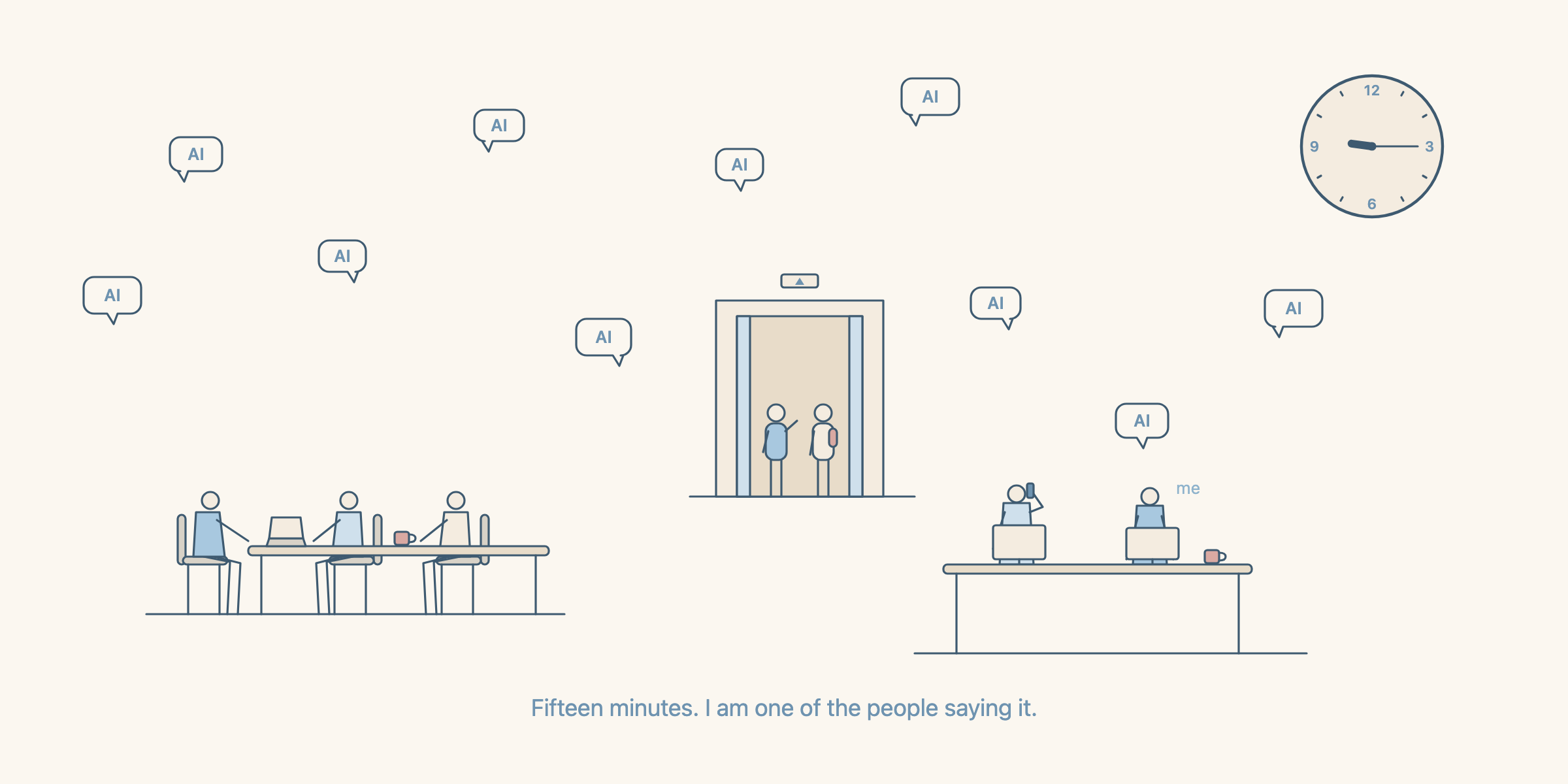
I want to be careful here, because I am one of the people saying it. I am not standing outside this glass house throwing rocks at it.
I have built multiple products with it: Ofuma, Apex Interviewer, and Doca. More, if you count my own site, my wife's, nihongo, and the engineering agent I have spent the better part of the last six months building at work. That engineering agent has been my entire focus. And on top of it I hold a second position in the AI Promotional Office (AIPO), which means driving adoption is not a hobby of mine. It is part of my job.
So I am not someone just shouting at a cloud. My commit history would testify against me.
And still, most mornings, something in me goes quiet and a little tired.
Let me tell you why.
Learning Japanese
I live in Japan at the moment and I have been to two (2) Japanese language schools. I paid for one, my company paid for the other. I also paid for an app called Bunpo. I showed up, I did the drills, I studied with the flashcards, I felt the specific joy of a sentence suddenly making sense.
I still struggle. Not "struggle" as in modest humblebragging but struggle as in there are moments where somebody says something perfectly ordinary to me and I stand there with nothing. I know I knew that word. I learned it. There are receipts.
Here is the thing every language teacher tells you, usually early, usually while you are still feeling clever: recognition is much easier than production. You can read a menu and feel completely fluent. Every character is familiar, every dish makes sense, you are practically Japanese. Then the waiter asks a follow-up question and absolutely nothing comes out of your mouth. 😅
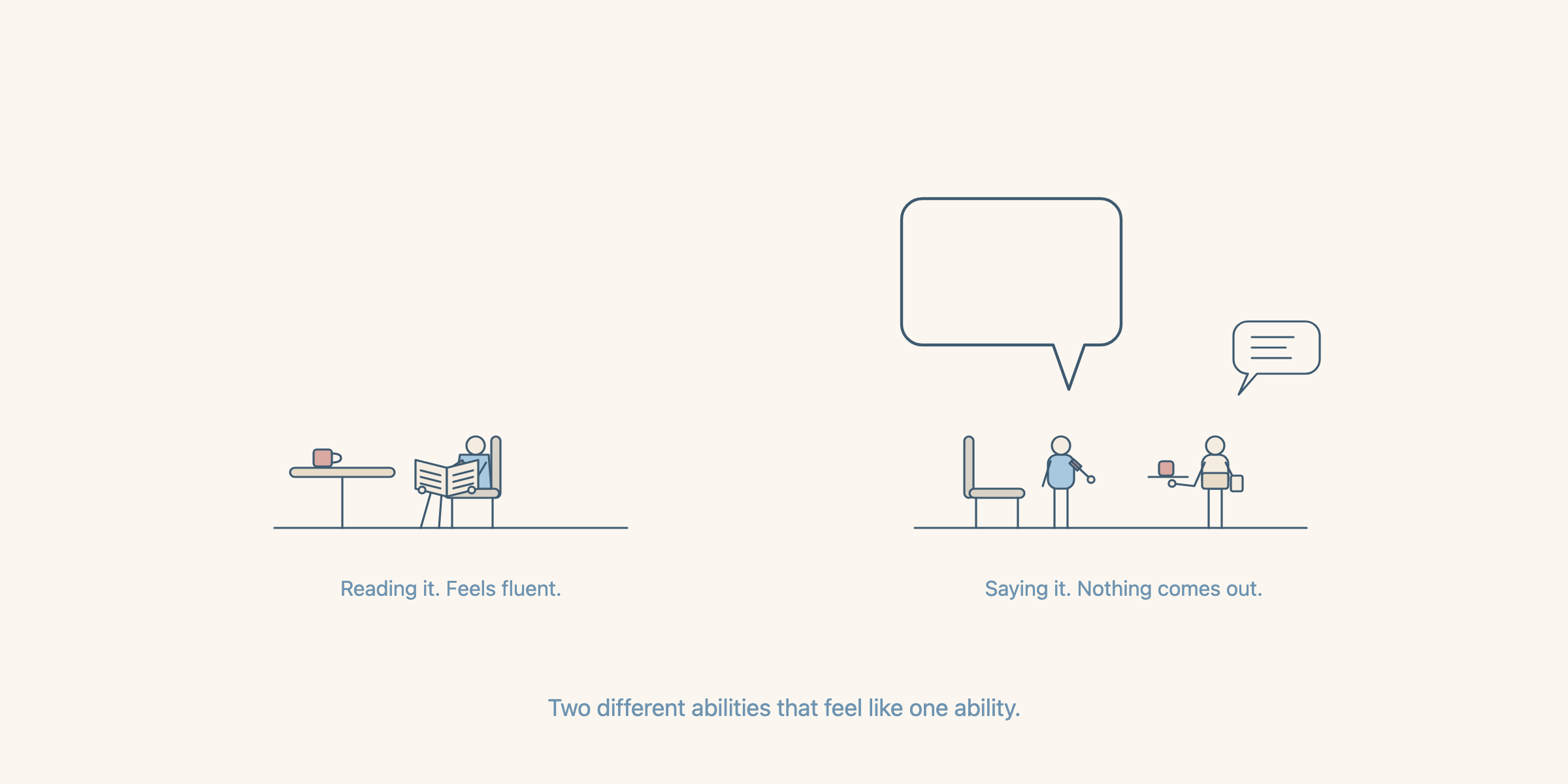
Those are two different abilities that feel like one ability. Recognising a thing when it is placed in front of you is quite cheap. Producing it, from nothing, under time pressure, when nobody has laid the options out for you, is expensive. And the maybe cruel part is that recognition does not just sit next to production. It impersonates it. Reading the menu feels like knowing Japanese right up until the exact second it matters.
The other thing they tell you is that a language is not stored, it is maintained. It is not a thing you own, like a certificate on a wall. It is closer to a muscle, or a garden. Stop showing up and it goes, quietly, without any warning. Nobody ever gets a message saying "you have lost 20% of your Japanese this quarter." You find out one day, in front of a waiter.
There is a joke in here I did not plan. One of the things I listed above, nihongo, is a tool I built recently so my wife and I could learn Japanese. I have since let one co-worker in. I built it in a fraction of the time I have spent not learning Japanese. Make of that what you will. I have.
What actually rots
When people say AI makes us dumber, the picture in their heads is usually someone who cannot do simple number division any more. Some obvious, visible hole where a skill used to be.
That is not what it looks like. It looks like reading a menu.
I read a lot of code I did not write. It is good code, mostly. I understand it. I can follow the logic, I can spot when something is off, I can ask for a change and I can tell that the change is better. Every single one of those is recognition. Every one of them is just like the menu.
The uncomfortable question I have started asking myself is this: could I have produced that from nothing? Not "do I understand what is on my screen", but could I have gotten there myself, on a blank file, with no options laid out (and trusty old stackoverflow and google)? For some things, obviously yes. For a genuinely uncomfortable and growing number of things, I am honestly not so sure. And I would not find out gradually. I would find out the way I find out about my Japanese, which is all at once, in front of someone, at the worst possible moment.
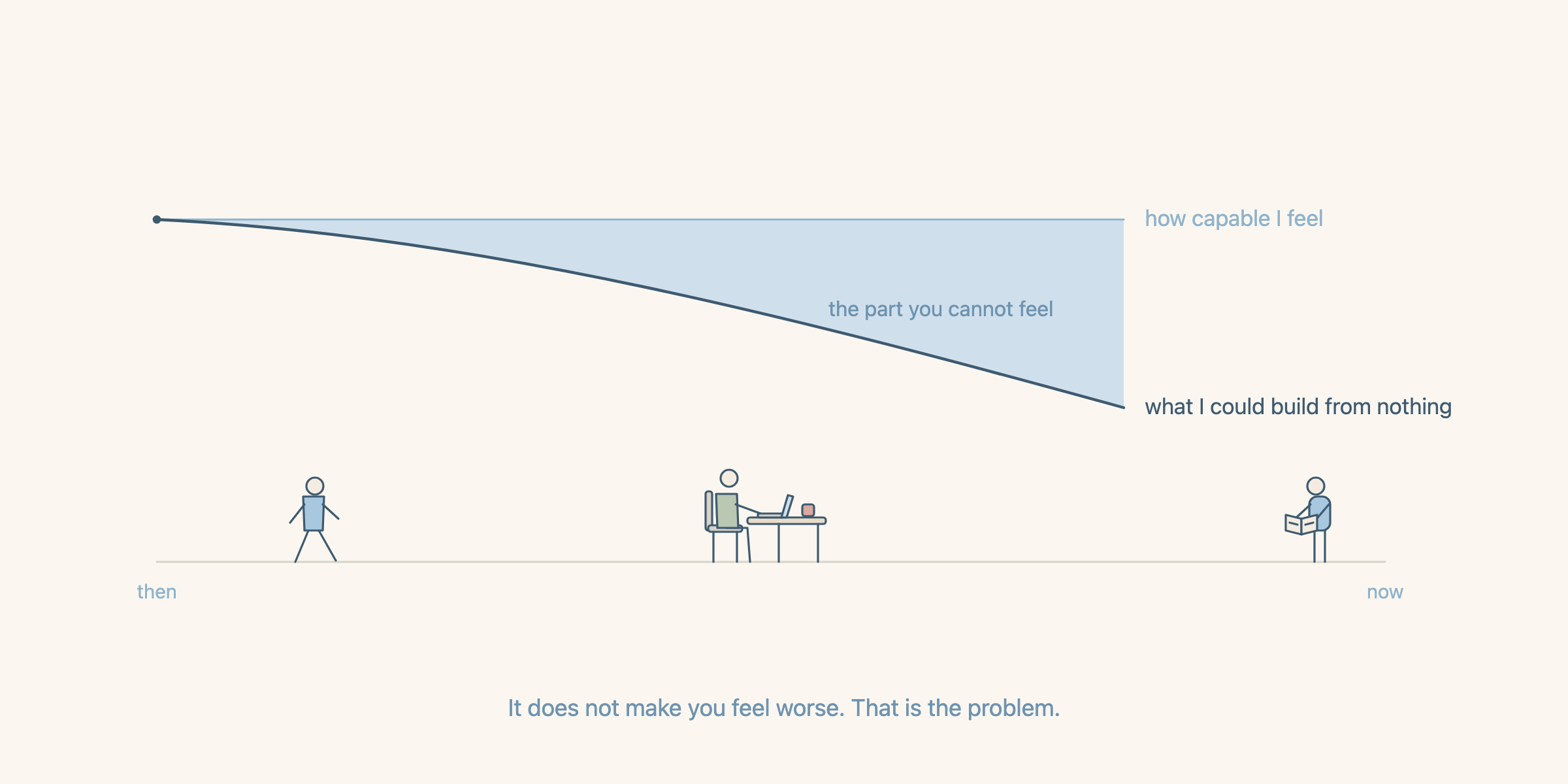
The atrophy is silent, and the feeling of competence stays fully intact the entire time. That is the part that gets me. It is not that the tool makes you worse and you feel worse. It is that it makes you worse and you feel fine. Better than fine. You are shipping more than you have ever shipped in your life.
The lie
The standard answer to all of this is comforting, and I have said it out loud, to other people, with a straight face: AI does the typing so I can focus on the high level decisions. Let the machine handle the boilerplate. I stay up here, on the interesting problems, doing architecture and judgment and taste.
I want to be honest about how that has actually gone for me.
I do not just hand over the typing. I ask it which of two designs is better. I ask it whether my plan has holes in it. I ask it to weigh a tradeoff. I ask it what I am forgetting. Those are not the boilerplate. Those are the high level decisions, and I outsourced them roughly nine seconds after I finished congratulating myself for not outsourcing them.
There is a second, quieter problem underneath that, and it is the one that actually worries me.
Your ability to judge an answer is downstream of having done the work yourself. A person who has never built anything can still sit in a room where two engineers disagree. What they cannot do is tell you which one is right. They can only tell you which one sounded more confident. And confidence is the single thing these tools have in unlimited, free, inexhaustible supply. They are never unsure. They will hand you a wrong answer in the exact same steady tone they use for a right one!
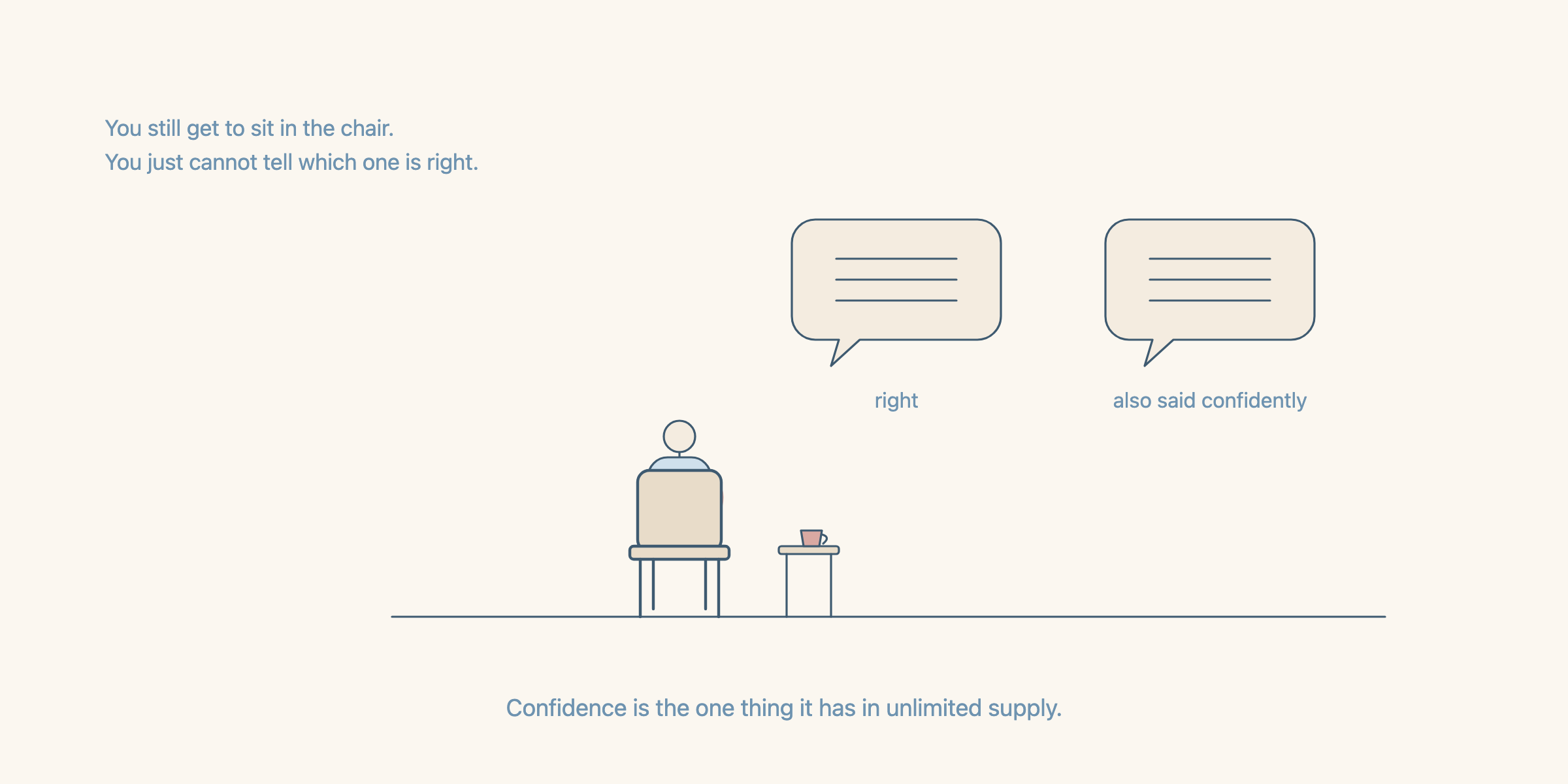
So "I will focus on the high level decisions" quietly assumes the high level skill survives on its own once you stop doing the low level work. I do not think it does. I think judgment is a callus. You get it from the boring reps you are now proudly skipping, and if you skip enough of them, you keep the job title of the person who makes high level decisions long after you have lost the ability to make them well.
You still get to sit in the chair. You just cannot tell which engineer is right any more.
The jobs part, where I do not have a clean answer
I will not pretend to be a policy person. But I do not like watching people lose their jobs, and I like it less when the response is "learn to prompt", delivered by someone whose job is not on the list (lol).
Bill Gates published a long essay on this in August, and I found myself agreeing with more of it than I expected. His view is that the transition ahead of us will be one of the most turbulent times in human history, that entry and mid level jobs are the ones most exposed, and that there will be some new jobs but, without the right policies, far fewer than exist today. He points out something I had never thought about properly: the tax system already rewards replacing a person with a machine. Hire someone and you pay payroll taxes on their earnings. Buy a robot and you can usually write it off straight away as a business expense. The incentive is not neutral. It has been quietly pushing one way the whole time.
His proposals are the ones that got the headlines. Tax AI tokens and robots, so the safety net has something to stand on when the income tax stops arriving. And an idea he calls "Human Reserved", where we deliberately set certain work aside for people only. He arrives at it through the carers who looked after his father through Alzheimer's, who knew when the man was hungry long after he had lost the words to say so. Something in that, he writes, was irreplaceably human.
I do not know if either of those is the right mechanism. Defining what counts is hard. The work moves to whichever country will not tax it. Where exactly does a robot start and a spreadsheet end. Fine, all fair.
But he is pointing at something real, and it is this: when a tool makes ten people's work doable by two, the value of the other eight did not evaporate. It moved. And right now it moves, more or less entirely, to whoever owns the model. That is not physics. That is not the tide coming in. That is a choice, made by people, and it can be made differently.
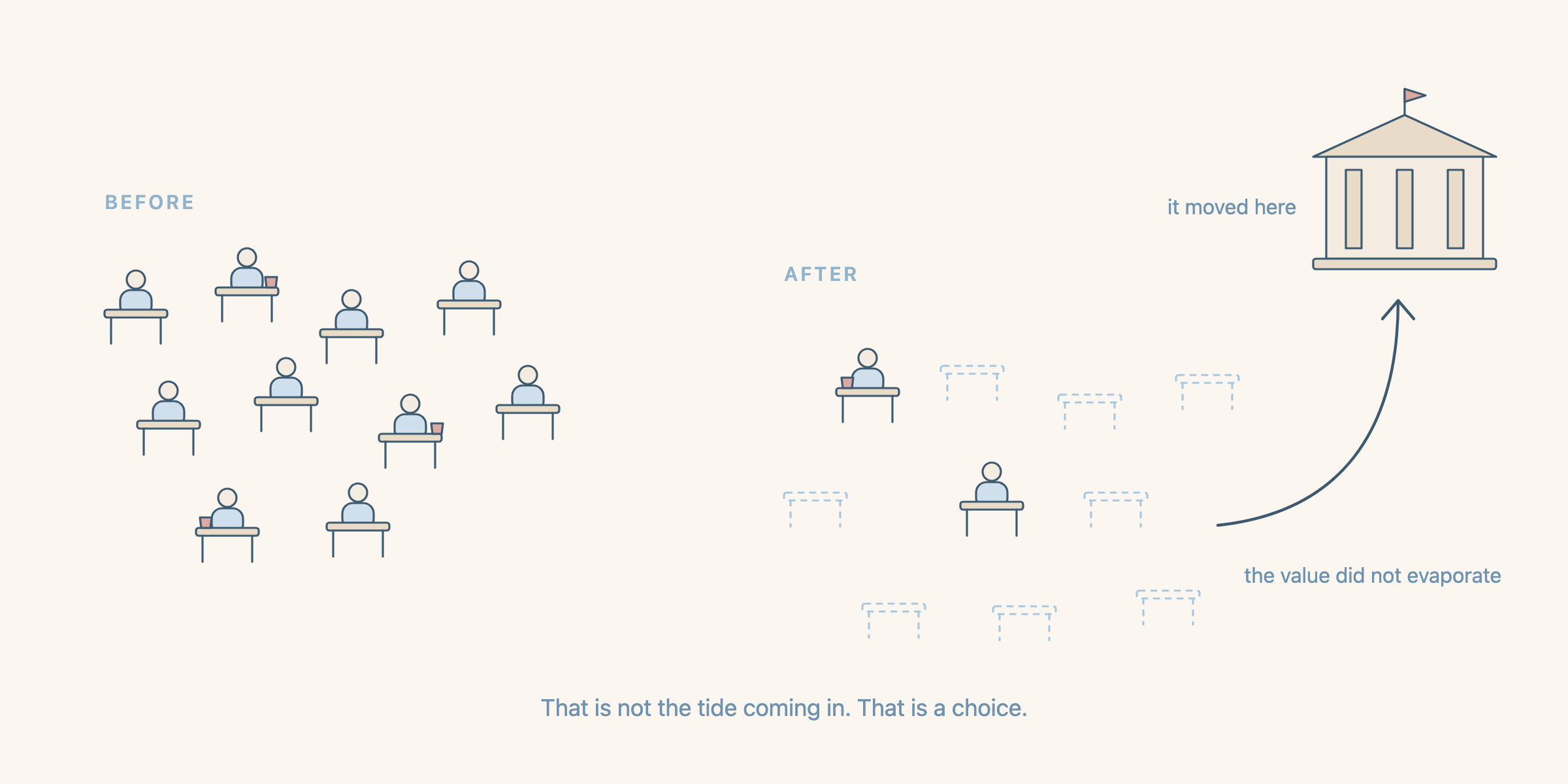
I am not going to pretend I know the mechanism. I just refuse to call it weather.
Two lines in that essay stopped me, because they are this article's whole argument arriving from a direction I did not expect. The first is his worry about education: the same tool that will let people learn more than ever could also lead to many people learning less. The second comes after he notes that heavier use tracks with less critical thinking, and that the effect is stronger in younger people. "This would be the worst possible time for humans to lose their critical thinking skills."
The worst possible time to get sloppy is the exact moment we built the thing that makes it easy.
"Just use AI", and then "AI is expensive, so use it efficiently"
This is the one that picks my interest a bit in a “hmmm” way, and it is the smallest complaint on the list, so let me get it out of my system!
For a good while the instruction everywhere was just use AI. Use it for everything. Use it more. Adoption numbers, usage dashboards, a gentle sense that if your name was not on the leaderboard you were not really trying.
Then the bills came in.
And so the instruction became: AI is expensive, so let us use it more efficiently. Same energy in exactly a new cardigan. Both of those sentences skip the identical question, which is the only question that ever mattered: is this the right tool for this particular job? One version said always. The new version says always, but cheaper. Nobody in either version stopped to check.
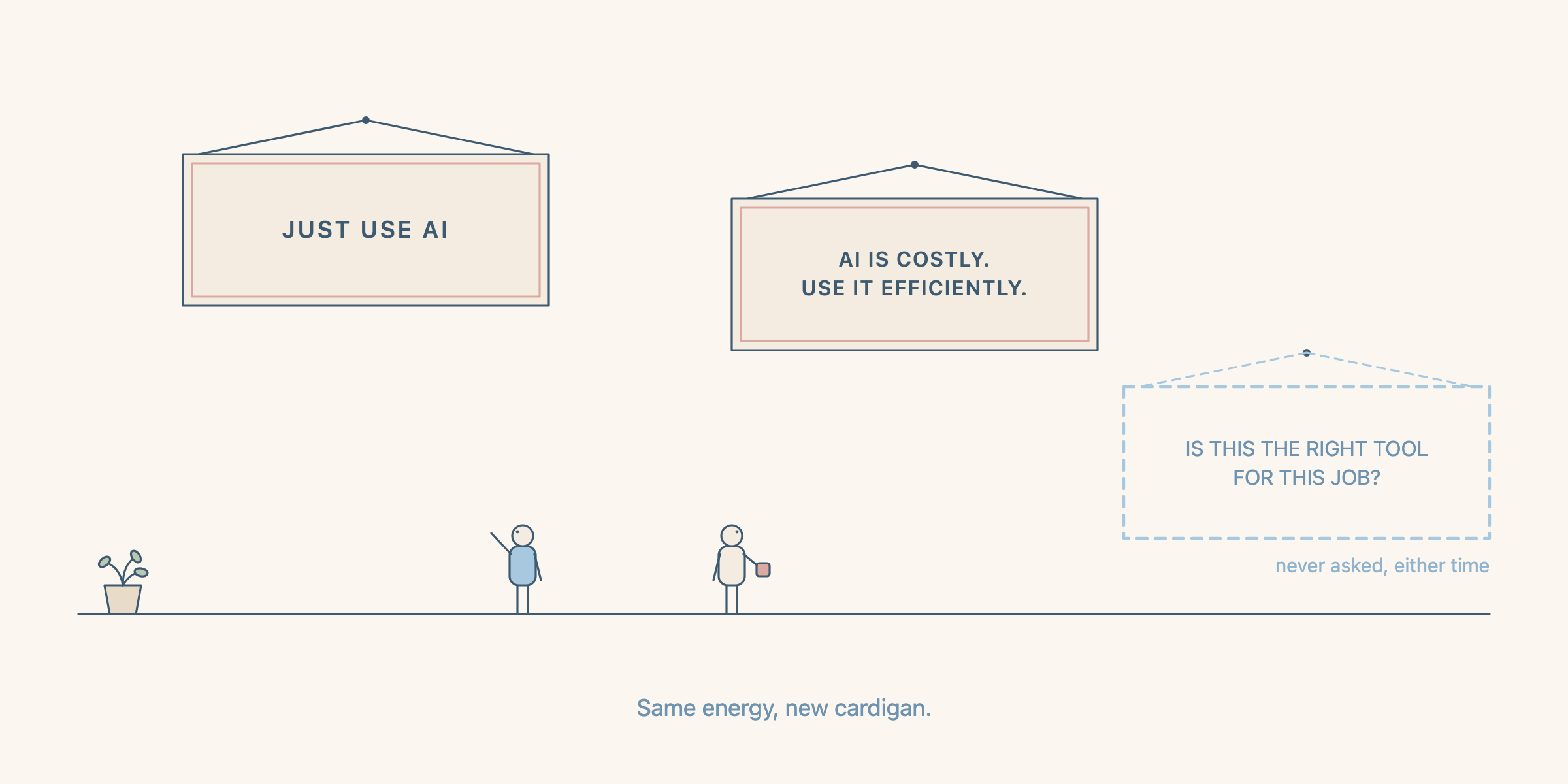
If the efficiency push actually meant "so let us think harder about when not to reach for it", I would be first in the queue with a party hat. Mostly, it means use a smaller model for the same thing you should not have been doing.
What I actually do about it
None of this ends with me deleting my tools lol. I would be lying, and you would be able to tell, because I would have to stop shipping. I like shipping 🤷🏽♂️.
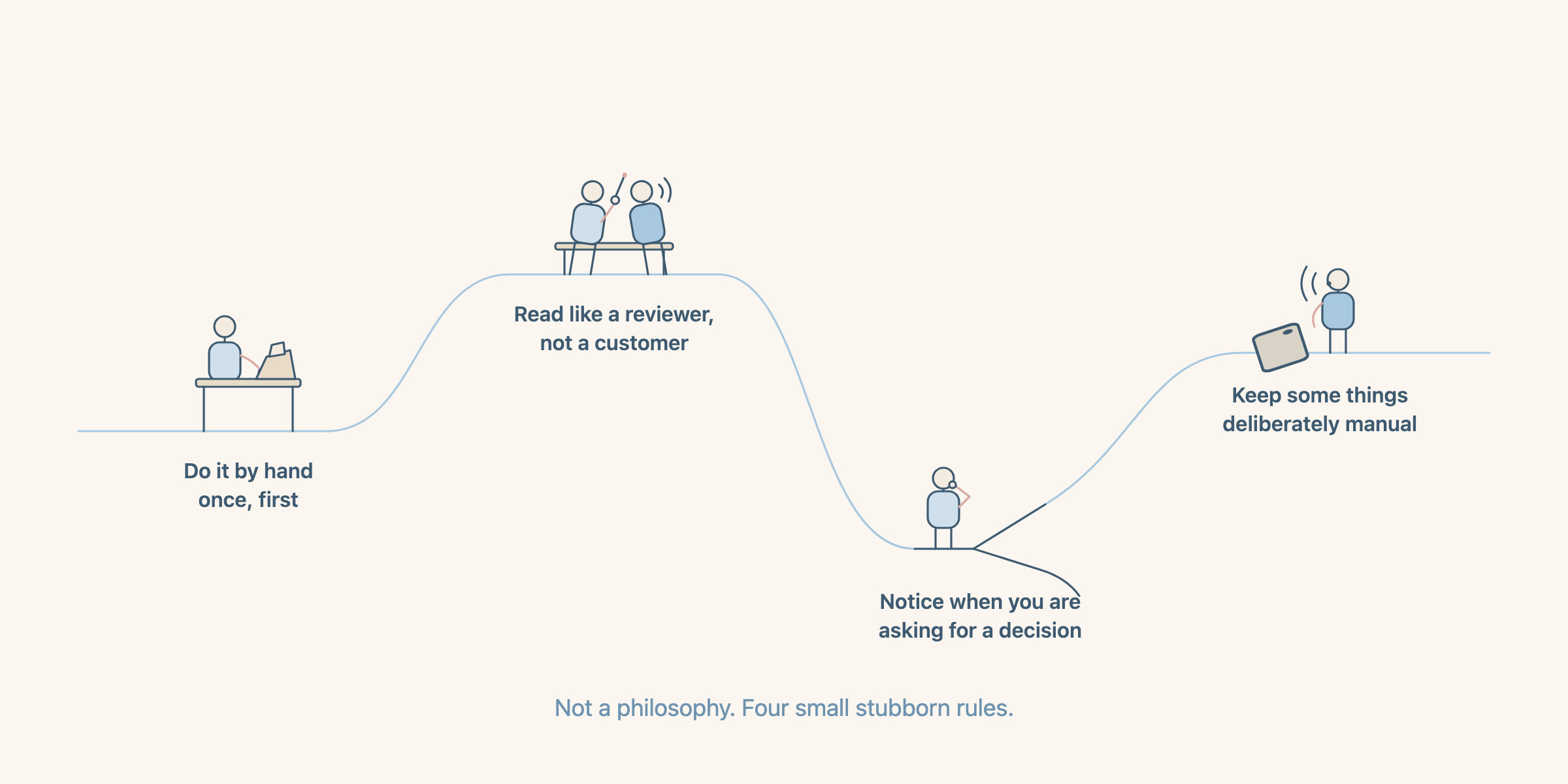
So here is where I have landed. Less a philosophy, more a set of small stubborn rules.
Do it by hand once, first. Before I let anything generate a thing I have never built before, I build a small ugly version myself. Not the whole thing. Enough to have actually held it. It costs me an hour and it buys me the ability to know when I am being handed nonsense.
Read like a reviewer, not like a customer. A customer reads to be satisfied. A reviewer reads to be unconvinced. Those produce two very different kinds of attention, and only one of them keeps you sharp. If I am nodding along, I am the customer, and I should be worried.
Notice when I am asking for a decision. Asking for the code is fine. Asking what to build, and then just doing that, is a different transaction, and I want to catch myself making it rather than sleepwalk through it.
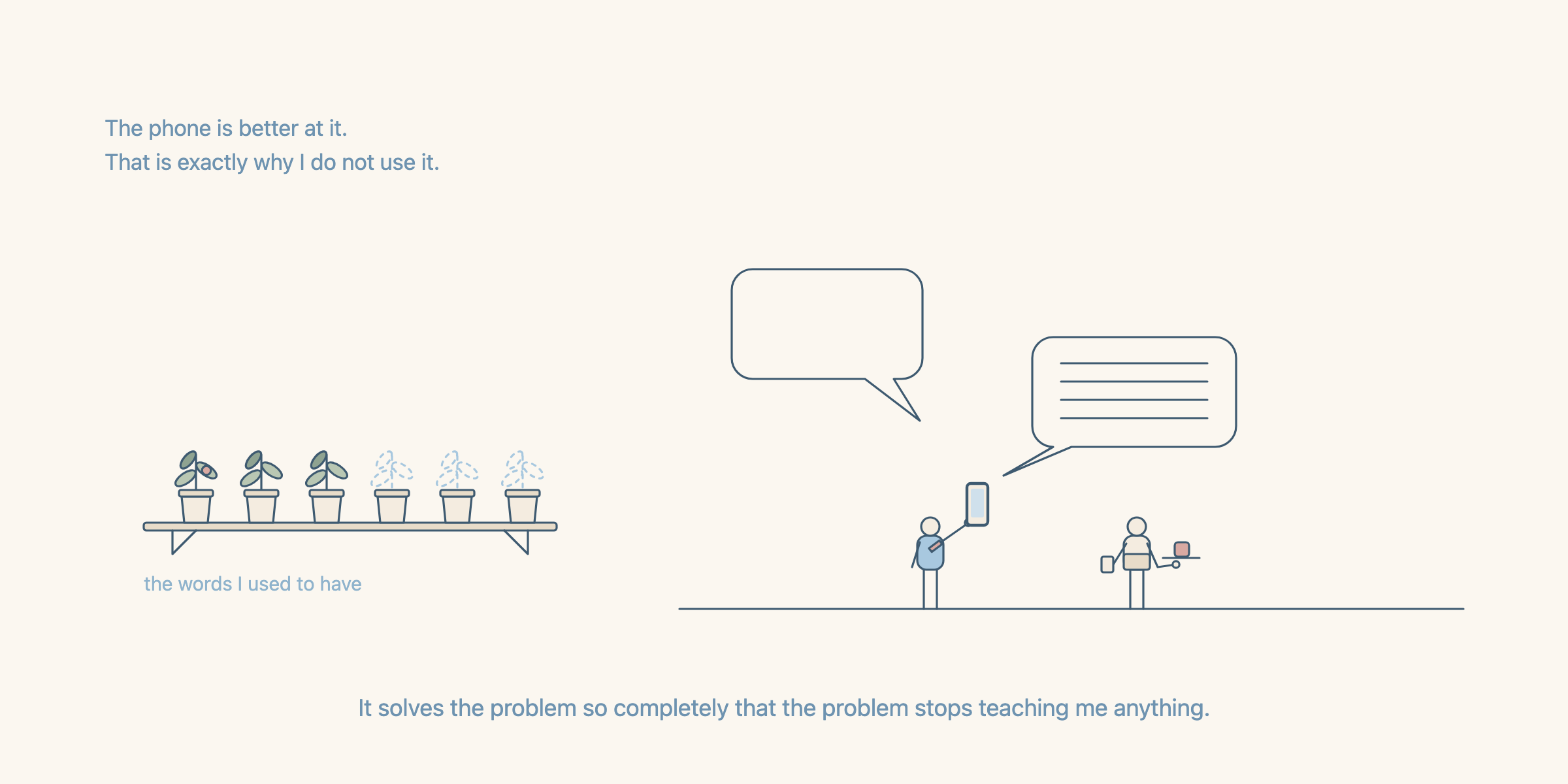
Keep some things deliberately manual. Not all of them, and not out of nostalgia. Just enough of them, chosen on purpose, so the muscle has something to lift. Same reason I still try to speak my terrible Japanese at people instead of quietly holding up my phone. The phone is better at it. That is exactly why I do not use it.
I should be honest about what those rules cost, because they are not free. Every single one of them is slower. Building the ugly version first is an hour I did not strictly have to spend. Reading like a reviewer takes longer than reading like a customer. Noticing that I am about to hand over a decision means stopping, and stopping is the one thing this whole industry is currently organised against.
That is the actual dilemma, and I do not want to pretend it resolves. Speed is what we are measured on. Speed is what is driving the instruction I was complaining about a moment ago, and it is a real reason, not a stupid one. So I am choosing to be slower on purpose in an environment that does not reward it, and I cannot promise you it is the right trade. Some days I think I am protecting something. Other days I think I am being precious while everyone else ships.
The only thing that keeps me on this side of it is that the speed is borrowed and the skill is not. You can always decide to go faster later. Getting the skill back is the part nobody has shown me how to do.
There is a name for what those four rules are protecting. Gates borrows it from education research: productive struggle, the cognitive work that actually builds understanding. The point is not that struggling is virtuous, which would be a miserable thing to believe. The point is that the struggle is where the learning physically happens, so a tool that removes it removes that too.
Because that is the whole thing, really. The translation app in my pocket is better at Japanese than I will ever be, and it will never once help me learn a single word. It solves the problem so completely that the problem stops teaching me anything. The convenience and the learning are not merely different, they are in direct competition, and convenience wins every single time you let it.
So no, I am not going to land this somewhere comfortable and tell you it all evens out. I think a fair amount of what AI is doing to us is bad, and I say that as the man whose second job title is spreading it. It is a phone in my pocket that speaks perfect Japanese, and every single time I reach for it I get the sentence and lose the reason to ever learn it.
Anyway. It is 9:15.
That is ten. Go back and count if you like, I said it exactly ten times too, and I meant every one of them. Which is the problem.
But solid food belongs to those who are of full age, that is, those who by reason of use have their senses exercised to discern both good and evil. - Hebrews 5:14