Can You Trust an AI Judge? Calibrating LLM Evaluators
Once one AI grades another AI's work, who grades the grader? The answer is a hundred-year-old statistic about how two people agree. No heavy formulas.
By Daniel Chiwuzoh ·
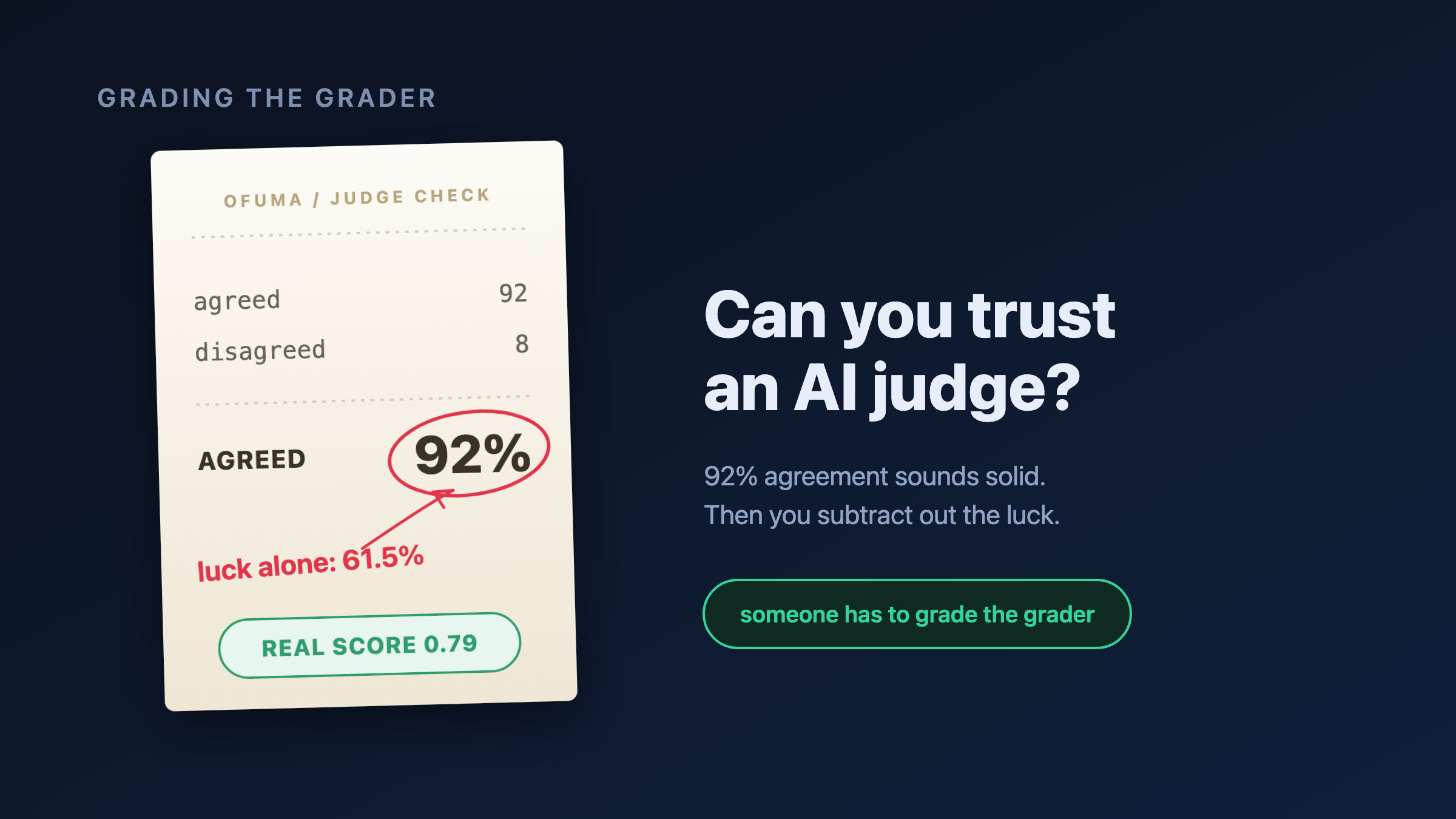
Imagine two teachers grading the same stack of a hundred essays, just pass or fail. You collect their verdicts and you notice they agreed on ninety of the hundred. Ninety percent agreement. Sounds like a solid, reliable pair of graders, right?
Now let me tell you one more thing. Ninety of those hundred essays were obvious, effortless passes. A coin could have passed them. A sleeping teacher could have passed them. Suddenly that ninety percent looks a lot less impressive, because most of the agreement came from cases where there was nothing to actually disagree about.
This little puzzle (how do you measure real agreement, the kind that isn't just luck?) sits right at the heart of a question I had to answer when building Ofuma. And honestly it is a question that creeps up on anyone who builds with language models, so let me walk to it slowly. Stay with me 🙂.
Why we end up with a robot grader at all
In Ofuma, you can use a language model to evaluate the output of another language model. You hand the judge a rubric ("is this answer factually correct, on the right tone, in the right format?") and it hands you back a pass or a fail. This is wonderful, because it means you can grade thousands of outputs without a human sitting there reading each one.
It is also slightly terrifying, because you have just put a fallible machine in charge of deciding whether another fallible machine did its job. If the judge is secretly bad, it will happily wave through garbage and you will never even know.
So we need to check the judge. And the only thing we can really check it against is a human. In Ofuma, every evaluation result can be human-reviewed: a person looks at the AI judge's pass/fail call and either approves it (the judge was right) or rejects it (the judge was wrong). Those human decisions become the ground truth, the answer key the judge gets measured against. So the question "can we trust the robot grader?" quietly becomes "how well does the robot grader agree with a human?"
Which is exactly the two-teachers problem from the start. We just need a fair way to measure agreement.
Cohen's Kappa: agreement minus luck
The fair measure is a statistic from 1960 called Cohen's Kappa. Do not let the Greek letter scare you, the idea is actually plain.
Kappa starts from a simple thought. There is the agreement you actually observed, and there is the agreement you'd have gotten by chance, just from how often each grader tends to say "pass." Real skill is the gap between those two. Kappa measures how much of the distance between "pure luck" and "perfect agreement" your graders actually closed.
In words rather than scary symbols:
Kappa = (how often they really agreed, minus how often they'd agree by luck) divided by (perfect agreement, minus how often they'd agree by luck)
If they agreed exactly as often as chance predicts, the top of that fraction is zero, and Kappa is zero: no skill demonstrated. If they agreed every single time, Kappa is one. And the everyday case lands somewhere in between.
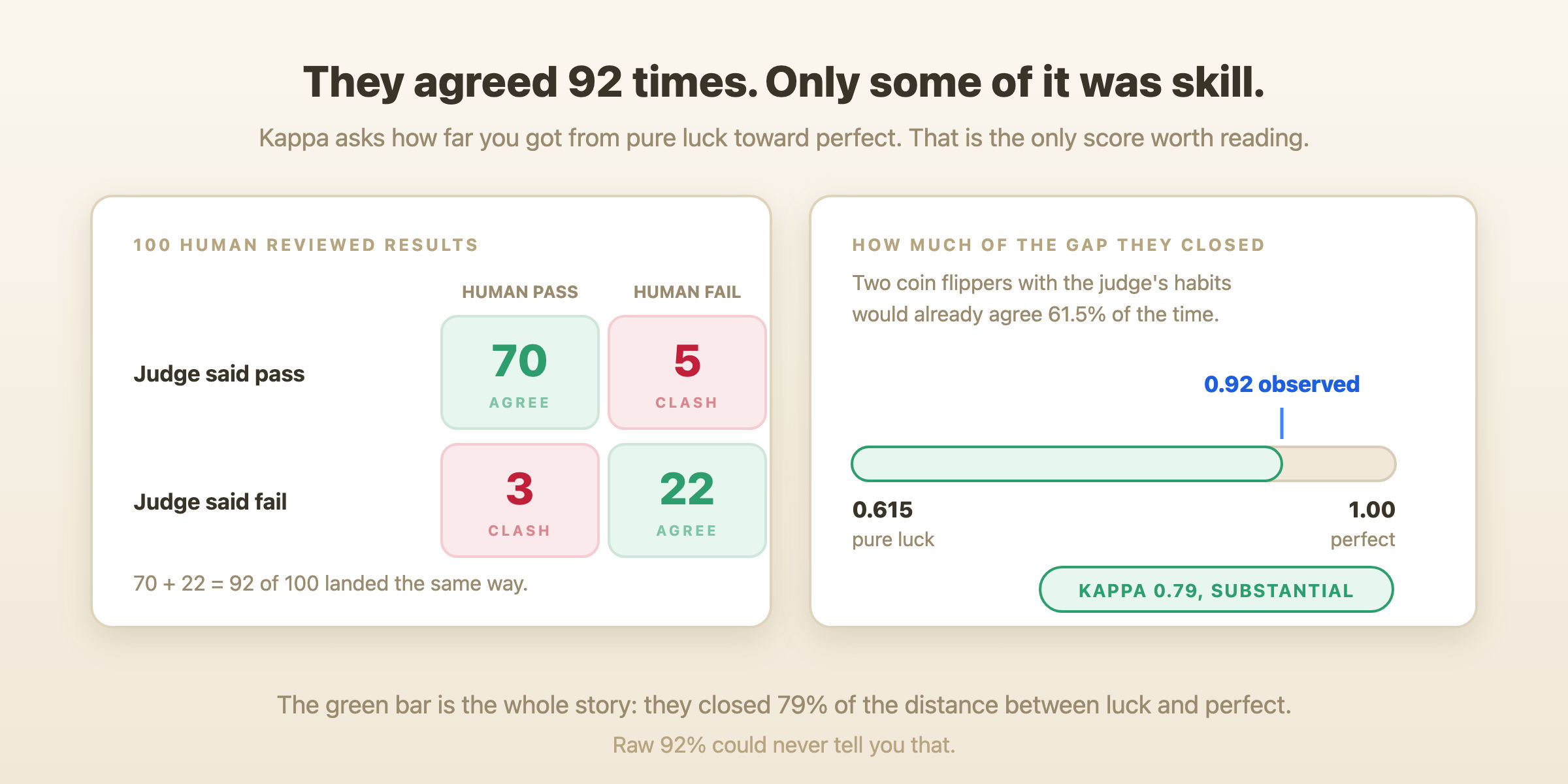
Let me make it real with the numbers from Ofuma's own calibration logic. Suppose you have a hundred human-reviewed results, and they break down like this:
The judge said pass and the human agreed: 70 times
The judge said pass but the human disagreed: 5 times
The judge said fail but the human would have passed: 3 times
The judge said fail and the human agreed: 22 times
First, the agreement you can see: they landed on the same verdict in 70 + 22 = 92 of the 100 cases. So observed agreement is 0.92.
Now the luck correction. The judge passed things 75% of the time (75 of 100). The human passed 73% of the time. If both were just flipping weighted coins with those tendencies, they'd both say pass about 0.75 times 0.73 of the time, and both say fail about 0.25 times 0.27 of the time. Add those up and chance agreement comes to about 0.615. So even two mindless coin-flippers with these exact habits would agree 61.5% of the time. That is the bar real agreement has to clear.
Plug it in: (0.92 minus 0.615) divided by (1 minus 0.615) = 0.305 divided by 0.385, which is about 0.79.
So the raw 92% agreement, once you subtract out the luck, is really a Kappa of 0.79. And there is a standard, if rough, scale for reading that number:
Kappa | What it means |
|---|---|
below 0 | worse than random |
0.00 to 0.20 | slight |
0.21 to 0.40 | fair |
0.41 to 0.60 | moderate |
0.61 to 0.80 | substantial |
0.81 to 1.00 | almost perfect |
0.79 sits comfortably in "substantial." Our robot grader is doing a genuinely good job, not just riding a stack of easy passes. That is the verdict the raw percentage could never give us.
A judge that's right doesn't mean a judge that knows it
Agreement is the big thing, but it is not the only thing I check. There is a subtler failure where the judge gets the verdict right but is wrong about how sure it should be.
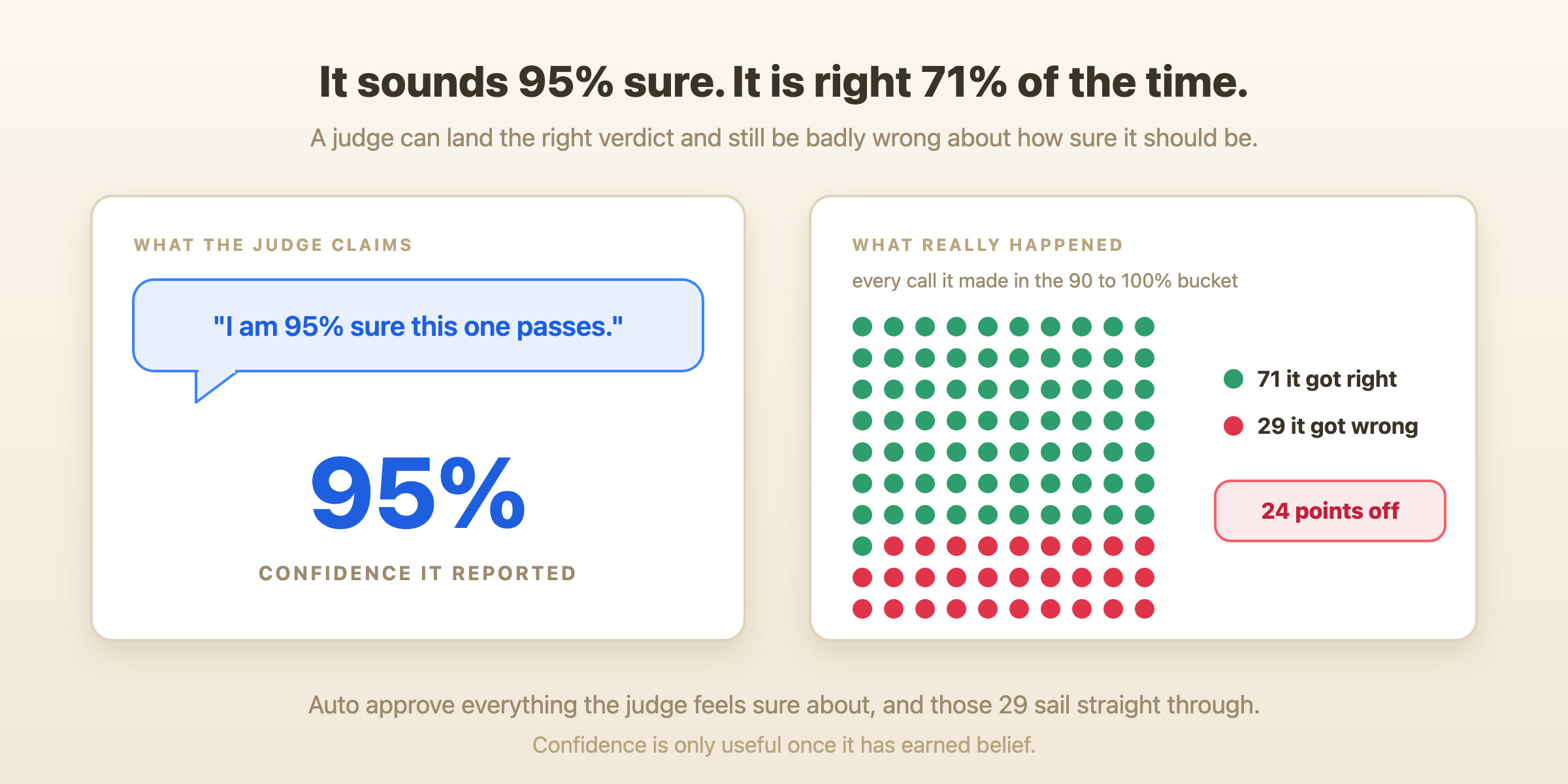
Ofuma's judges can report a confidence number: "I'm 95% sure this passes." A well-calibrated judge is one whose confidence means what it says. Of all the times it claims 95% confidence, it really should be right about 95% of the time. The way to check this is to bucket results by their stated confidence and compare each bucket's claim to its actual accuracy. If the 90-to-100% bucket is right only 71% of the time, the judge is overconfident: it talks like an expert and performs like a coin that is only slightly better than chance.
Why care? Because the whole appeal of confidence is automation. You might want to auto-approve any result the judge is highly confident about, and only send the uncertain ones to a human. But if the judge is overconfident, "highly confident" is a lie, and you will be auto-approving bad outputs all day. Calibration is what tells you whether that confidence number is actually safe to act on. I hope you are still with me 🥱.
The slow rot: catching drift over time
Here is the failure that scares me the most, because it is completely silent.
You calibrate your judge today, get a lovely Kappa of 0.82, and walk away satisfied. Months pass. The model provider quietly ships a new version. Your users start asking harder questions. Your rubric gets tweaked. None of these announce themselves. And little by little, your judge gets worse, while every dashboard still cheerfully says "we calibrated it, it's fine."
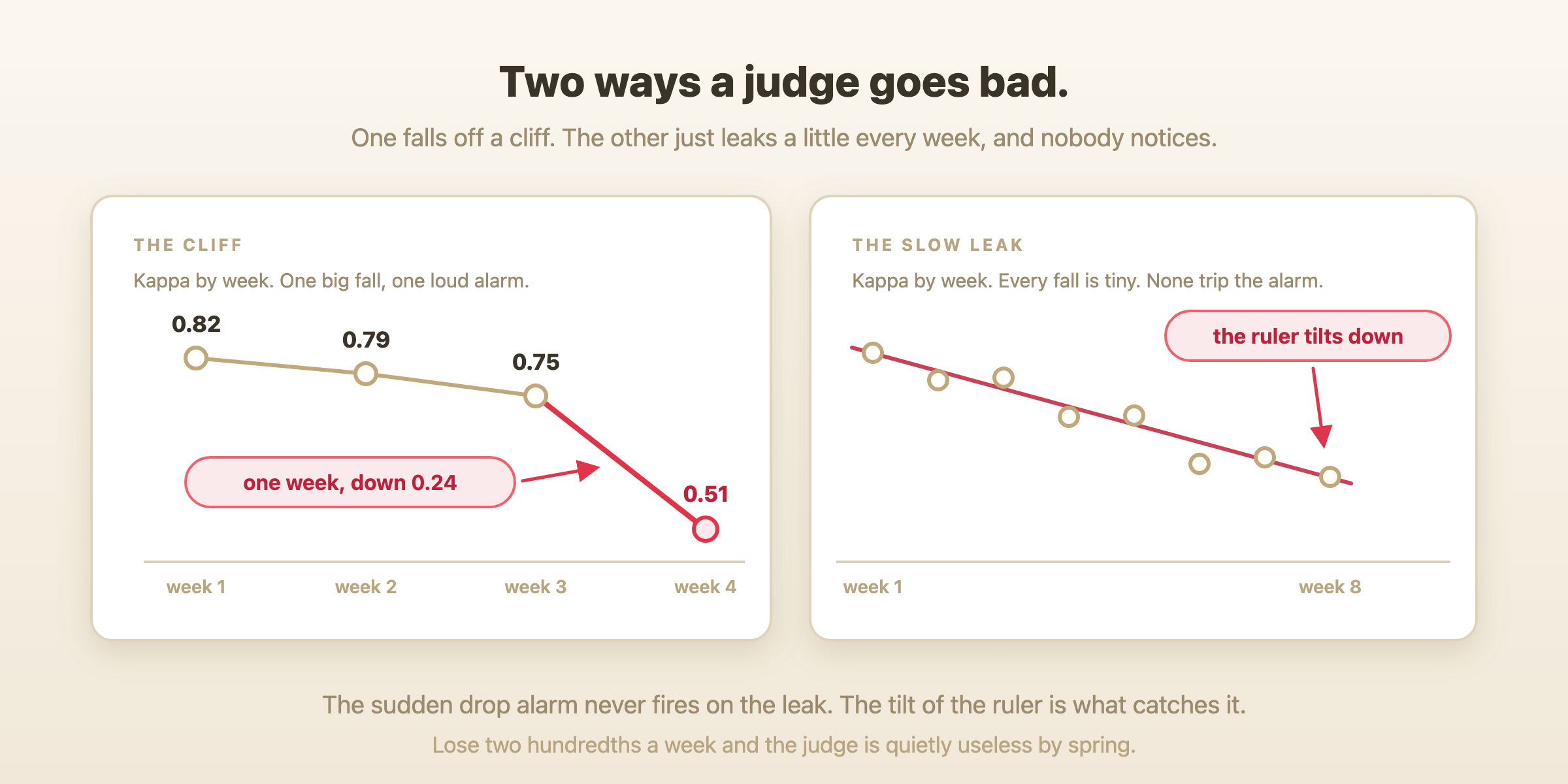
To catch this, Ofuma slices the review history into weekly windows and computes Kappa for each one. Now you can actually watch the trend:
Week | Kappa |
|---|---|
1 | 0.82 |
2 | 0.79 |
3 | 0.75 |
4 | 0.51 |
Two different alarms can go off here. The drop from week 3 to week 4 (0.75 down to 0.51) is a sudden fall, a quarter-point cliff between two windows, and Ofuma flags any single drop bigger than 0.2. That usually means something concrete changed: a model upgrade, a rubric edit.
But there is also a gentler, sneakier pattern: a Kappa that just leaks downward a tiny bit every week. No single drop is dramatic enough to trip the cliff alarm, yet the line is unmistakably heading down. To catch that one, I fit a straight line through the weekly Kappas and look at its slope.
The slope, without the algebra
You do not need the formula to feel what a slope is. Take the weekly Kappas and plot them as dots on a graph, week along the bottom, Kappa up the side. Now lay a ruler through the dots so it splits them as evenly as possible. The tilt of that ruler is the slope.
If the ruler tilts down as you move right, Kappa is declining week over week, and that is drift. If it tilts up, the judge is improving. If it lies flat, the judge is stable. That is the entire idea: one number that captures which way the trend is leaning, and how steeply.
The mechanism underneath is just measuring, for each dot, how far it sits from the center of the cloud in two directions (left/right in time, and up/down in Kappa) and then asking whether those two distances tend to move together. When points that are early in time tend to sit high, and points that are late tend to sit low, the math comes out negative: down-and-to-the-right, decline. Ofuma then reads the steepness against thresholds (a gentle negative slope is low-severity gradual drift, a steep one is high-severity) and recommends re-calibrating the rubric before the rot spreads. (Maybe I'll do a whole piece on fitting lines to noisy data another time 🤔.)
The beauty of the slope is that it sees the slow leak that the cliff-alarm misses. A judge that loses two hundredths of a Kappa point a week never trips a sudden-drop alarm, but the ruler tilts down all the same, and you get warned while you still have time to act. Silent decline caught, quietly!
So, can you trust an AI judge?
You can, but only the way you'd trust a brand new employee. Not on faith, and not forever on the strength of one single good day. You trust it by checking it against people who know the right answer, by measuring agreement honestly enough to subtract out dumb luck, by refusing to believe its confidence until that confidence has earned belief, and by watching the trend line so that the day it starts slipping, a graph tells you before a customer does.
That, in the end, is all calibration really is: the humility to keep grading the grader.
All the ways of a man are clean in his own eyes; but the Lord weigheth the spirits. - Proverbs 16:2