Many Households, One Roof: Why I Moved Every Site onto One Server
Three different boxes became one netcup VPS called nagaya. What runs on it, the decisions behind it, and the things I chose not to build.
By Daniel Chiwuzoh ·
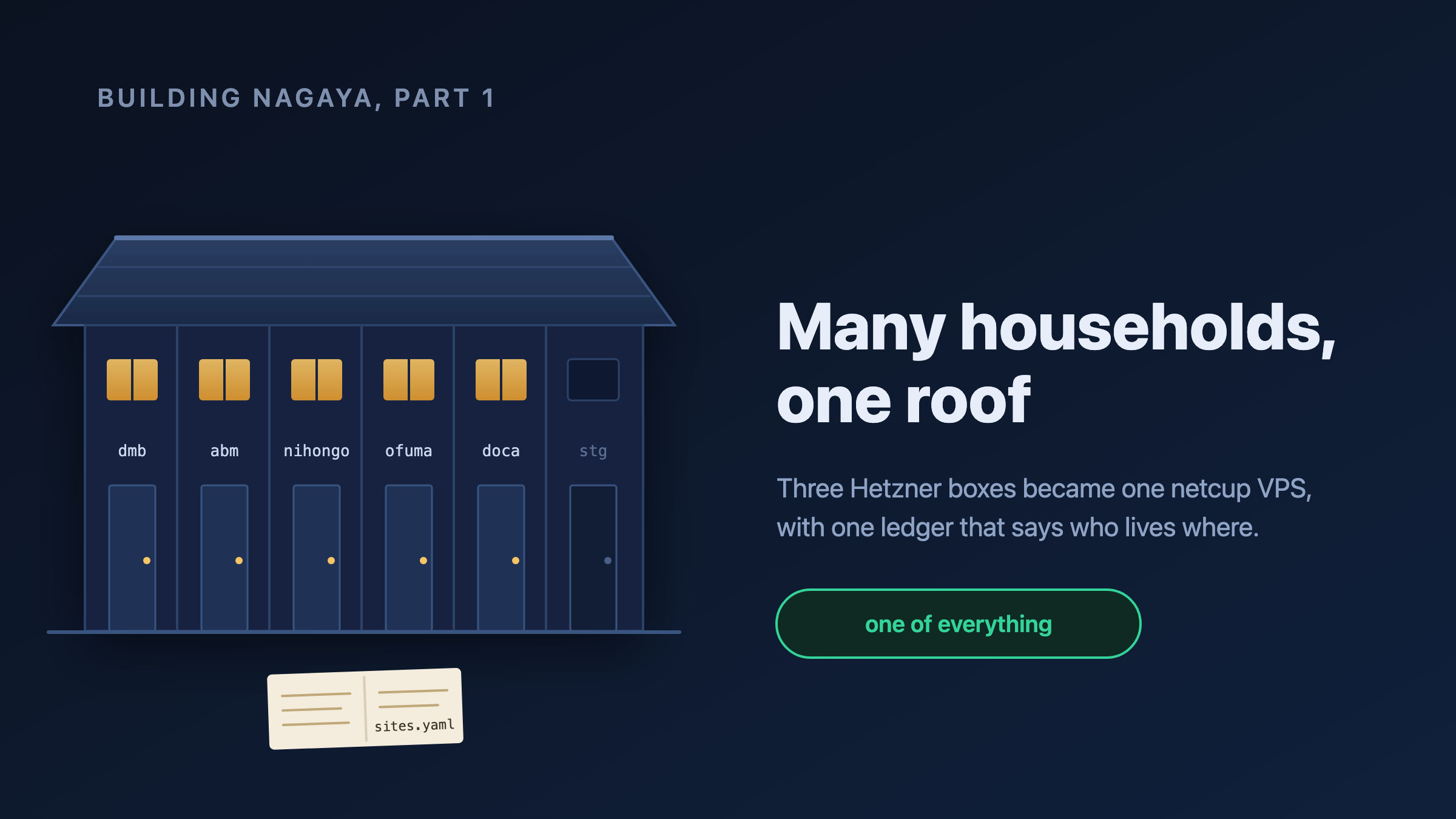
In old Edo, the city that became Tokyo, a lot of ordinary people lived in a nagaya (長屋), a row house. Picture one long wooden building, cut into narrow homes side by side. Every household has its own front door and its own little room, and lives its own life. But they all share one roof, one well at the end of the lane, and one landlord, who keeps a single ledger of who lives where and who owes what.
If you grew up in Lagos you already know this building. It's the face-me-I-face-you: rooms down both sides of a corridor, every family behind its own door, one kitchen and one bathroom at the back, and one landlord who comes round at the end of the month 😅.
The clever part of a row house isn't the rooms. It's the sharing. One roof is cheaper to build and cheaper to fix than ten roofs. One well is easier to keep clean than ten wells. And because there's one ledger, the landlord never has to walk the lane to find out who lives in number four. He reads it.
Hold onto that picture, because it's exactly what I built for my websites this year, and I named it after the building. nagaya (長屋, a row house, many households under one roof) is one server that runs every futari and ofuma site I have. This is the first article in a series about how it's put together, and this one is about the why.
Where I was before
If you read How I Migrated from DigitalOcean to Hetzner, you know the last chapter. I swapped a managed Kubernetes cluster for small rented computers from Hetzner, each running Docker, and my bill dropped by nearly 90 percent. That was a good move and I don't regret it.
Quick refresher on two words from that article, because everything below leans on them. A server is just a computer that's always on and answers when a browser knocks. A container is a program sealed up together with everything it needs to run (the right language version, the right libraries), so the server doesn't care what's inside. Docker is the tool that runs containers, and Docker Compose is a single text file that says "run these containers together on this one machine".
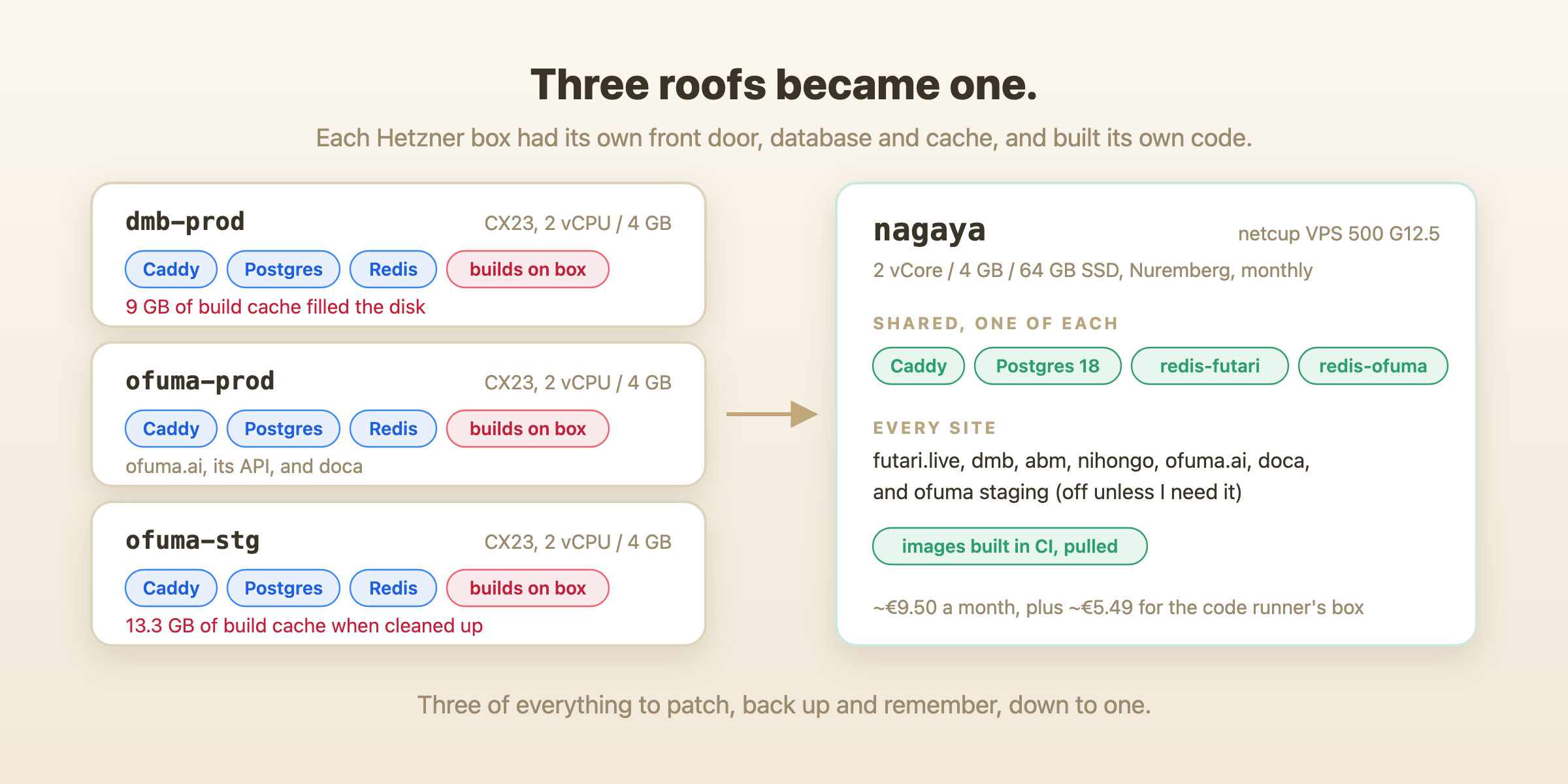
By this autumn I had three of those Hetzner boxes, all the same size:
Box | What it served |
|---|---|
| dmb, abm and nihongo .futari.live |
| ofuma.ai, its API, and doca |
| ofuma's staging copies, and a piston code runner |
Each box was its own house with its own roof. The ofuma boxes each ran their own web server, their own Postgres database and their own Redis. On the dmb box, dmb's Compose project owned the database and the cache, and abm and nihongo attached to them over a network I'd made by hand. Every deploy logged into the box, pulled the code, and built the app right there on the server. And the DNS for both domains (DNS is the internet's phone book, the thing that turns dmb.futari.live into the address of a machine) sat at Namecheap, where I bought the names.
Nothing was on fire. It worked but it had a cost that didn't show up on the invoice.
What made me move
Three boxes cost three times what one does (not just financial cost), they leave three of everything to patch, back up and remember. Three operating systems to update. Three sets of firewall rules. Three databases to back up, three places a disk could quietly fill up.
And one of them did fill up. Building the apps on the box itself meant every deploy left compiler leftovers behind, and on the dmb box that build cache grew to 9 GB and filled the disk. A vue-tsc build on the box could take 1 to 2 GB of memory by itself, and building on the box is what forced the dmb box to have a swapfile at all. When the old ofuma staging box was cleaned up later, it was holding 13.3 GB of build cache on its own.
Two more things tipped it. Hetzner raised its prices on 15 June 2026 and had stock problems, which is what had already pushed another box I run over to netcup. And ofuma and doca are kept alive but are quiet these days, so they no longer justified a whole box each.
So the plan was simple to say: one server, every site under its roof, and one ledger that says who lives where.
The new building
The new home is a netcup VPS 500 G12.5, in Nuremberg, on a monthly plan with no commitment. It runs Ubuntu 24.04 Minimal and Docker, and its hostname is nagaya.
Here's what the whole thing costs each month, from the repo's notes:
Item | Monthly |
|---|---|
netcup VPS 500 G12.5, no commitment | ~€9.50 (€8.26 on a 12-month term) |
Hetzner CX23, kept for the code runner | ~€5.49 |
Cloudflare (DNS, CDN, WAF, certificates, email routing) | €0 |
Cloudflare R2 (backups and Terraform state, well under 10 GB) | €0 |
GHCR (private images, within the free storage) | €0 |
Total for compute | ~€15/mo, replacing three Hetzner boxes |
You'll notice a Hetzner box is still on that list. I'll come back to it, because that one stays out of the row house on purpose.
The move itself went quickly once the groundwork was done. The first commit in the repo is dated 3 October 2026. nihongo, abm and dmb moved over on 4 October, ofuma on the 5th, and on the 6th the two old Hetzner boxes were snapshotted and deleted. How you move live sites one at a time without dropping anyone's data has its own article, One Lever at a Time.
Who lives there
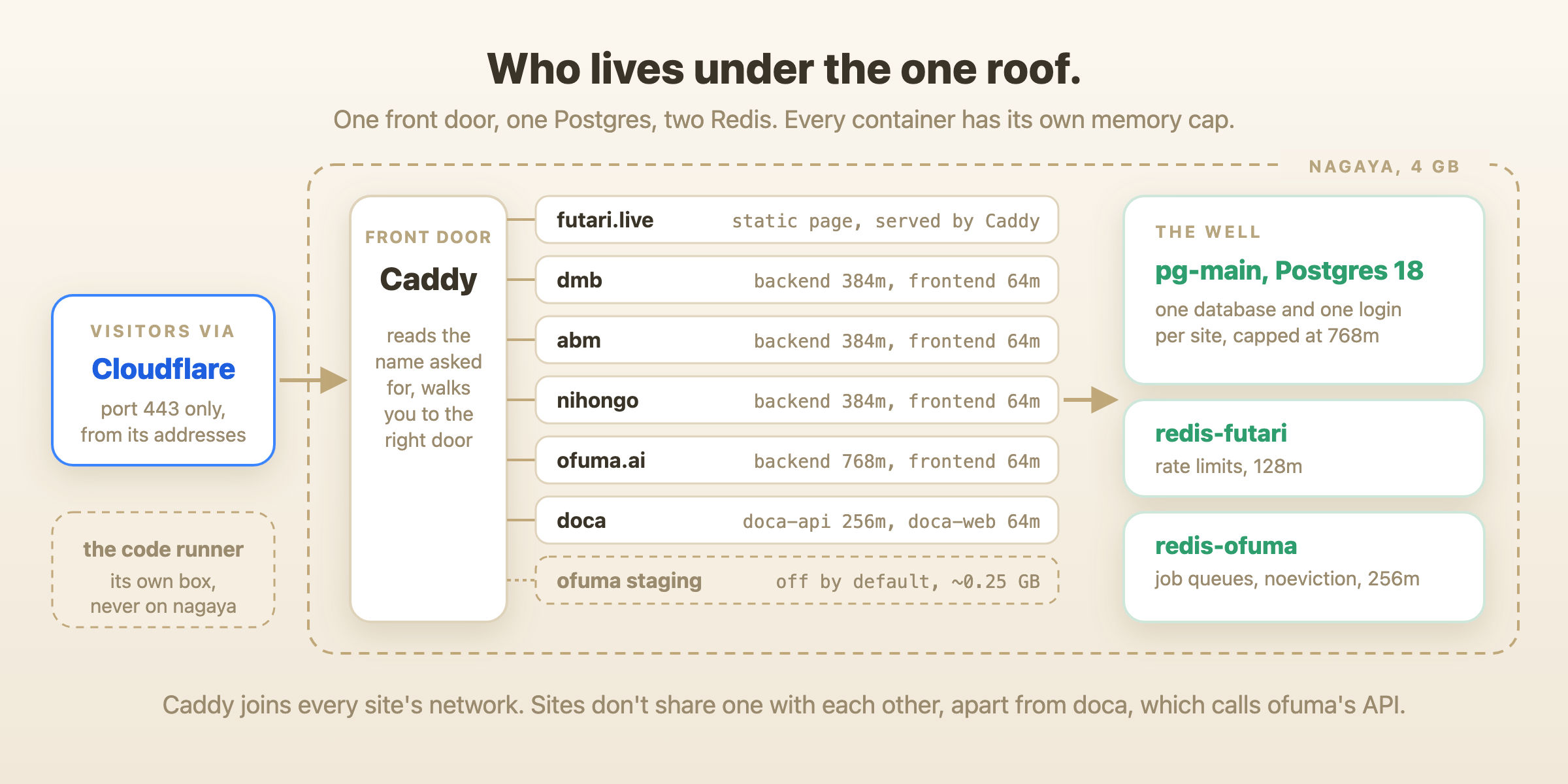
Under the one roof today:
futari.live, a static page that the web server hands out directly
dmb, abm and nihongo .futari.live, each a frontend and a backend
ofuma.ai and its API
doca, which lives alongside ofuma and shares its database
ofuma staging, a full copy of ofuma for testing, switched off unless I need it
They share the expensive things, the way the row house shares its well. There's one Postgres (version 18) with one database and one login per site, one Redis for the futari sites and one for ofuma, and one Caddy at the front door.
Caddy is a reverse proxy. Every visitor arrives at the same front door, and the reverse proxy reads which name they asked for and walks them to the right room: this request to dmb's container, that one to ofuma's. Here's a real piece of the file it reads:
dmb.futari.live {
	import tls_futari_live
	encode zstd gzip
	reverse_proxy futari-dmb-frontend:8080 {
		import proxy_headers
	}
}
That says: when someone asks for dmb.futari.live, use the futari certificate, compress the response, and pass the request to the container called futari-dmb-frontend on port 8080.
But each household keeps its own door. Every site gets its own private network, so dmb's containers can reach the database and their own backend but not ofuma's. And every container has a memory cap, so if one of them leaks memory, that one container is killed and restarts instead of taking the whole building down with it. I hope you're still with me 🙂.
The landlord's ledger
Now the ledger. Everything that runs on the box, every DNS record, every memory cap and every alert threshold is written down in one file in the repo, sites.yaml. A program in the repo (pnpm render) reads that file and writes out everything the box actually runs on: the Caddy configuration above, one Compose file per site, the scheduled jobs, the firewall rules. Those outputs are committed to git and never edited by hand.
Here's what a site looks like in the ledger, trimmed down:
nihongo:
  repo: thedumebi/nihongo.futari
  database: nihongo
  services:
    backend:
      port: 3008
      mem: 384m
      health: /healthcheck
    frontend:
      port: 8080
      mem: 64m
      depends_on: [backend]
  routes: { nihongo: frontend:8080 }   # nihongo.futari.live
Read it top to bottom and you know where nihongo's code lives, which database it uses, how much memory each half may use, and which web address points at which container. Adding a subdomain is an entry in this file and a merge. Why it's one file, and the bug that taught me what "shared" should and shouldn't mean, is another article (One Drawing for the Whole Building).
The decisions, on one page
Here's the short version of every big choice, with the article that tells its story.
Area | Decision | The full story |
|---|---|---|
Server | netcup VPS 500 G12.5 (2 vCore, 4 GB, 64 GB SSD), monthly | this article |
Orchestration | Docker Compose and Caddy, not k3s | this article |
What runs | every futari and ofuma site; the code runner stays off | this article |
Registry |
| |
Images and deploys | built in each app's CI, pushed to GHCR, pulled by the box | Cut at the Quarry |
DNS, TLS, firewall | Cloudflare in front, proxied, through Terraform; port 443 open to Cloudflare only | The Gatehouse |
Cloudflare Email Routing receives for futari.live; Brevo still sends | A New Caretaker for the Letterboxes | |
Moving the sites | one site at a time, one DNS record each | One Lever at a Time |
Backups | nightly | The Spare Key |
Staging | ofuma staging off by default, sharing Redis safely | The Guest Room |
Memory and alerts | a cap on every container, and emails about the box itself | The Meter That Beeps |
Node and nginx | one version for every app, declared once | Re-keying the Whole Building |
Origin certificates | Cloudflare Origin CA, installed by | The Revoked Certificate |
Three of these are worth unpacking here, because they're about the shape of the building itself.
Compose, not k3s
If you read the Hetzner article you might expect me to be done with Kubernetes for good, and mostly I am. But there's a small version of it called k3s, built for single machines, and it was a fair question whether nagaya should run it.
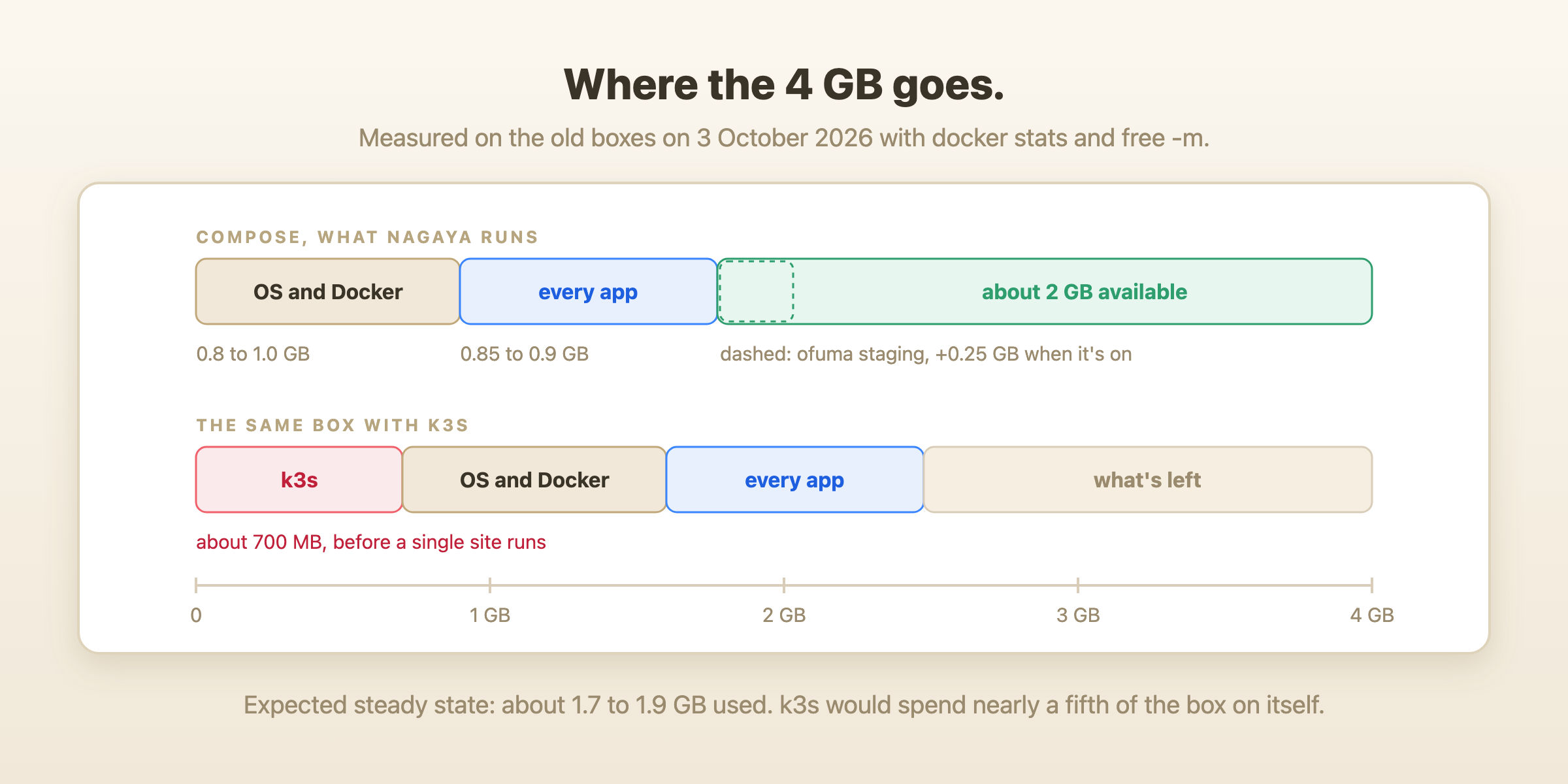
The answer was no, for two reasons. First, k3s costs about 700 MB of a 4 GB box. That's memory doing the conducting rather than running any site, and it's nearly a fifth of everything I have. Second, every app was already shaped for Compose. Moving to k3s meant rewriting every one of them into Kubernetes manifests, for no gain the sites would notice.
What k3s would have bought me is zero-downtime rolling updates, where the new version starts up before the old one stops. Another box I run on netcup does need that, because it's a storefront taking payments. These sites can take a blip of a few seconds on deploy. So that one goes on the list of things I'm deliberately not doing, further down.
For a sense of how much room is left without it, I measured everything on the old boxes on 3 October 2026 with docker stats and free -m. All the app containers together came to about 0.85 to 0.9 GB. The operating system and Docker take another 0.8 to 1.0 GB. That puts the expected steady state at about 1.7 to 1.9 GB used, with about 2 GB available, and ofuma staging adds roughly 0.25 GB when it's on. Watching that budget is the job of The Meter That Beeps.
A ledger, not a control panel
There are good tools that already do "many sites on one server", with a nice dashboard on top. Coolify and Dokploy are the two I looked at. They're good! But each one brings a dashboard, a database and an agent of its own onto the box, and keeps its state inside that database.
That last part is what decided it. If the truth about what runs where lives in a tool's database, I can only see it by logging into the tool, and I can't see what changed last Tuesday. With sites.yaml and the generated files, all of it is in git. A pull request shows me exactly what's about to change, down to the line of Caddy configuration, before anything touches the box.
The box itself is driven by one script in the repo, bin/nagaya, with plain commands: apply, deploy, stg up and stg down, backup, restore, drill, alerts and status. Cloudflare and the GitHub secrets are handled by Terraform (a tool that takes a description of what you want and makes the real thing match). The box isn't in Terraform. It's in bin/nagaya.
The tenant who lives next door
Now the Hetzner box that's still on the bill.
One of my projects runs code that strangers type in. It sends their Python, JavaScript, Java, C++ and so on to a code runner called Piston, which runs it in a sandbox and sends back the result. To do that, Piston needs a privileged container. A normal container is fenced in. A privileged one has the keys to the whole machine, so if anyone ever escaped Piston's sandbox, they'd be root on the host.
On nagaya, the host holds every database and every app's decryption keys. Putting a program whose whole job is running strangers' code in the same building as all of that would be like letting a lodger set up a welding shop in the shared hallway. And there's a second, plainer reason: Java and C++ compiles spike to about 1.4 GB of memory, and the 4 GB box isn't sized for that.
So when the old boxes were retired, the old ofuma staging box wasn't deleted. It became the code runner's box: just Caddy and Piston, nothing else. It costs about €5.49 a month. I did check the alternatives first. The free public Piston API has been whitelist-only (non-commercial) since February 2026, and Judge0's free tier allows 50 runs a day.
Deliberately not doing
Some things were left out on purpose, and the repo lists them so I don't drift into building them later:
Zero-downtime deploys. A deploy replaces a container in place, so each site has a few seconds' blip. That's fine for these sites.
Building images on the box, ever. It's what forced dmb's swapfile and filled its disk. Every app's images are built in GitHub Actions and the box only pulls them. That's Cut at the Quarry.
A metrics stack like Prometheus and Grafana.
nagaya alertsandnagaya statuscover what a single small box needs, and Better Stack checks each site from outside to answer "is it up?".The code runner on nagaya. Above.
Managing the R2 backup buckets through Terraform. Those buckets hold the only copies of the data that live off the box. A misread plan that replaced one isn't worth saving one click in a dashboard, so they stay dashboard-managed.
Authenticated Origin Pulls, where Cloudflare proves itself to the box with its own certificate. The firewall already admits only Cloudflare's addresses on port 443. It's worth doing later. It wasn't needed to move.
What's coming in this series
Each part takes one decision and the thing that went wrong first, which is usually why the decision exists.
Many Households, One Roof (this one): why one server, and what's on it.
One Drawing for the Whole Building:
sites.yaml, the one file that declares everything, and why the box only ever reads generated files.Cut at the Quarry: building images in CI instead of on the box, and a deploy key that can only run three commands.
The Gatehouse: moving both domains behind Cloudflare with Terraform, and a firewall that only lets Cloudflare in.
A New Caretaker for the Letterboxes: an update to my custom domain email article, now that Cloudflare receives the mail for futari.live.
One Lever at a Time: moving live sites over one at a time, and why the database is restored before the app ever starts.
The Spare Key: nightly backups to R2, and the bug that made a backup report success while saving one database.
The Guest Room: ofuma staging, off by default, and sharing Redis without staging stealing production's jobs.
The Meter That Beeps: the 4 GB memory budget, and alerts that email me when the box is actually short.
Re-keying the Whole Building: one Node and one nginx version for every app, declared once.
The Revoked Certificate: the box served a revoked certificate for weeks before every site went down, and what changed after.
Behold, how good and how pleasant it is for brethren to dwell together in unity! - Psalm 133:1